If your furnace ignites, runs for a few seconds, and shuts down abruptly, a dirty flame sensor is usually the reason. Homeowners in Northfield, Macedonia, Twinsburg, Hudson, and Brecksville run into this on cold winter mornings, and the part responsible is a thin metal rod about the thickness of a pencil lead.
The flame sensor sits directly in the burner path to confirm that ignition actually happened. Modern gas furnaces do this through flame rectification. The control module sends an alternating current through the sensor rod, the burner flame ionizes the gas around it, and that ionized path converts the alternating current into a weak direct current signal traveling back to the board. As long as the board reads that signal, it holds the gas valve open. If it does not read the signal within the flame-establishing period, it closes the gas valve immediately so unburned fuel cannot accumulate in the heat exchanger.
That window is short, commonly a few seconds on a residential furnace, and the exact value is set by the equipment manufacturer rather than by code. ANSI Z21.20, the standard covering automatic gas ignition systems and components, verifies timings like the flame-establishing period and flame failure response time against the limits the manufacturer declares for that specific system. Your furnace’s sequence of operation, printed on the inside of the access panel, is where that number lives.
Over months of normal heating cycles, combustion leaves carbon, airborne debris, and oxidation on the rod. That buildup works as an electrical insulator. Once it thickens enough, the microamp signal drops below the threshold the board needs, and the system shuts down even though the burner lit correctly.
Identifying Bad Flame Sensor Symptoms
A dirty sensor rod produces a distinct operating pattern, one that looks different from a blower motor failure or a thermostat problem. Recognizing it early means fixing the issue before the house goes cold.
Watch for these signs during heating cycles:
- The burners ignite normally, then go out a few seconds later.
- The furnace attempts ignition three to five consecutive times before dropping into a safety lockout.
- Your vents blow unheated air because the system keeps cycling through failed ignition sequences.
- The problem appears during the first cold snap of the season, after a humid summer has left oxidation on the rod.
Where Is the Flame Sensor on a Furnace?
Find the component before you inspect it. The flame sensor sits inside the burner compartment, positioned opposite the hot surface igniter or pilot assembly so the rod sits in the path of the last burner to light.
The part is a thin metal rod mounted on a white ceramic porcelain insulator, with a single wire running from the base terminal to the integrated control board. On most residential units, one quarter-inch hex screw holds the mounting bracket to the burner box.
Furnace Flame Sensor Cleaning: Step-by-Step Guide
Cleaning the flame sensor is a manageable job with basic tools. Work methodically, because the burner components around it are easy to knock out of alignment.
- Turn off electrical power at the furnace service switch or at your home’s main breaker panel.
- Shut off the manual gas valve on the supply line outside the furnace cabinet. This is a precaution while the burner compartment is open. Do not loosen or disturb any gas connections.
- Remove the upper furnace access door by lifting it off its retaining slots.
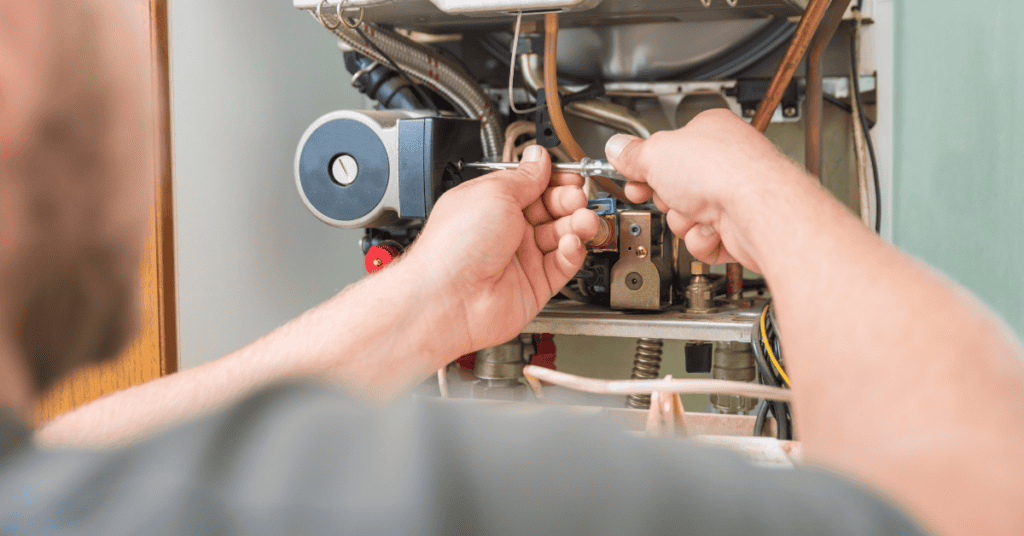
- Locate the sensor bracket. Remove the single mounting screw with a quarter-inch nut driver, then slide the rod out of the burner assembly.
- Polish the metal rod gently with fine emery cloth or 0000 steel wool. Work along the rod until the dark carbon film is gone and clean metal shows. Skip coarse sandpaper, because the scratches it leaves collect new soot faster than a smooth surface does.
- Wipe the rod with a dry microfiber cloth to clear loose debris and any shed abrasive fibers. Do not touch the cleaned metal with bare skin, since body oils burn onto the rod and attract soot.
- Reinsert the sensor into the burner compartment and tighten the retaining screw.
- Reinstall the access panel, reopen the gas supply valve, and restore electrical power. Watch the next ignition cycle to confirm the burners light and stay lit.
Take caution around combustion equipment. If you are uneasy working near gas lines, or if the porcelain insulator shows any visible cracking, stop and call an HVAC professional.
When Cleaning Does Not Fix the Problem
Polishing the rod does not resolve every ignition failure. If the furnace still shuts down afterward, the fault is electrical or mechanical rather than a layer of carbon.
A flame sensor in good condition produces a direct current signal in the low single-digit microamps, and the control board needs that signal to stay above a minimum threshold to hold the gas valve open. Both the healthy range and the cutoff vary by manufacturer, so the number that matters is the one printed in your unit’s service literature, not a general figure. When the signal falls below that threshold, the board shuts the burners down. After a set number of failed attempts, most boards enter a lockout and retry automatically after a delay, commonly about an hour.
At that point, replacing the sensor makes more sense than cleaning it again. Pulling the part, polishing the rod, and reinstalling it takes 15 to 30 minutes. Installing a new sensor takes the same 15 to 30 minutes and the same access, and on a rod with degraded metallurgy or a compromised insulator, scrubbing buys a few weeks at best.
Other safety controls can shut burners down in ways that look identical from the thermostat. A blocked flue, a tripping pressure switch, or a weak draft inducer all produce short burner cycles. When cleaning does not clear the issue, professional diagnostic tools are what isolate the actual point of failure.
Preventing Sensor Buildup with Annual Maintenance
Annual service is what keeps this from becoming a midwinter problem in the first place. The flame sensor is inspected, cleaned, and tested with a digital multimeter during every seasonal tune-up.
Professional heating maintenance and repair clears combustion residue across the full burner assembly, not just the sensor rod. Technicians measure the microamp signal under load, check burner alignment, and verify the electrical ground connections that flame rectification depends on. A sensor reading 1.2 µA in October is the one that fails in January, and a multimeter is the only way to see it coming.
Schedule Heating Service with Jackson Comfort Services
A dirty flame sensor leaves a house cold while the furnace itself is working exactly as designed. Periodic cleaning removes the carbon layer that blocks flame rectification and lets the control board read the signal it needs.
When polishing the rod does not resolve the shutdowns, gas furnace service covers the full diagnostic. Technicians trace the entire ignition sequence, check how the control board responds at each step, and replace sensors that have failed structurally. Catching an ignition fault early also keeps the repeated start attempts from putting unnecessary wear on the igniter and gas valve.
If your furnace keeps shutting off after it lights, let an experienced technician find out why. Jackson Comfort Services provides heating inspections and repairs across Northfield and the Greater Cleveland-Akron area. With over 100 years of trusted service, our licensed technicians offer upfront pricing, same-day service, and 1-hour appointment windows. Contact our team to book your furnace inspection today.